
Synopsis
In the modern world, technology is no longer just a separate industry; it is the infrastructure of human life. However, most traditional schools approach computer classes through passive consumption, teaching children how to open documents or browse the web. At Vardhman Podar Learn School, our signature “Nayee Approach” completely turns this dynamic around. We believe that to thrive in the upcoming decades, children must move from being passive consumers of technology to becoming active digital creators. Guided by the innovative modules of the Podar curriculum, we integrate basic coding, visual algorithms, and computational logic into our elementary school timetable. As admissions open 2026-27 from Nursery to Class 9, our amazing campus features state-of-the-art ICT labs that deliver an elite modern way of education. This blog explores how learning to code early strengthens critical thinking, enhances mathematical reasoning, and drives holistic growth, establishing VPLS as the best school in Seoni for building the architects of the digital age.
Table of Contents
The Consumer Trap: Why Basic Computer Literacy Is No Longer Enough
Computational Logic: Training the Brain to Think in Systematic Sequences
Visual Programming First: How Scratch and Blockly Make Coding Child’s Play
Cross-Functional Synthesis: How Coding Sharpens Mathematics and English Skills
Modern Way of Education: Fostering Digital Creation on an Elite Campus
Admissions Open 2026-27: Future-Proofing Your Child’s Intelligence in Seoni
VPLS Group: Engineering Visionary Global Citizens for a Century
The Consumer Trap: Why Basic Computer Literacy Is No Longer Enough
Many parents look at a child who can effortlessly open mobile applications, play digital games, or stream videos and assume they are automatically “tech-savvy.” In reality, this is a dangerous consumer trap. Passively scrolling through an interface designed by someone else does not build a child’s intellect; it simply reduces their attention span. In a global economy increasingly driven by automated logistics and data analytics, knowing how to type a document is no longer a competitive advantage. True digital literacy means understanding how software operates behind the screen. At VPLS, we teach our elementary students to open up the hood of technology, helping them understand the underlying commands and code lines that power our digital world.
Computational Logic: Training the Brain to Think in Systematic Sequences
Learning to code in elementary school is rarely about manufacturing thousands of professional software programmers; it is about building a powerful mental framework called computational logic. Computational logic is a core life competency that trains the human brain to approach large, overwhelming challenges by systematically breaking them down into a series of smaller, highly manageable steps. When a child writes a simple computer program, they practice variable classification, pattern recognition, and algorithmic design. This structural thinking transforms how they study, helping them plan complex science experiments, organize lengthy essays, and tackle challenging multi-step math problems with absolute clarity and calm.
Visual Programming First: How Scratch and Blockly Make Coding Child’s Play
If you introduce a seven-year-old child to traditional, text-based code languages like C++ or Python on day one, they will immediately get frustrated by rigid punctuation and syntax rules. To make technology joyful, the Podar curriculum utilizes block-based visual programming environments like Scratch and Blockly. In these specialized interfaces, code lines are transformed into colorful, interlocking puzzle blocks that represent logical actions, variables, and loops. Students drag and snap these blocks together to build their own interactive stories, program digital animations, and design simple video games. This tactile approach keeps learning highly creative, allowing young minds to master deep computer concepts like conditional logic ($if/then$ statements) through pure play.
Cross-Functional Synthesis: How Coding Sharpens Mathematics and English Skills
Our primary school pedagogy explicitly highlights that coding does not exist in an isolated vacuum. It acts as a powerful catalyst for your child’s holistic growth by synthesizing core school subjects. When an elementary student codes an animation to move an object across a digital screen, they are actively practicing the coordinate geometry, angle configurations, and structural variables taught in their mathematics lab. Similarly, creating a branching digital story forces them to map out complex narratives, expand their English vocabulary, and refine their sentence structures. This cross-functional synthesis ensures that technical logic and creative arts reinforce each other beautifully.
Modern Way of Education: Fostering Digital Creation on an Elite Campus
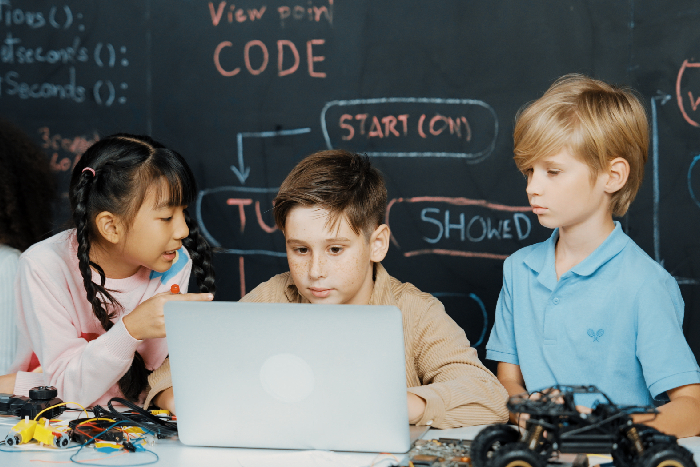
Nurturing tech-savvy creators requires a physical learning environment that matches international standards. Our custom-engineered school infrastructure Seoni features an amazing campus loaded with high-speed, secure ICT innovation laboratories. Inside these digital labs, every child enjoys dedicated personal access to modern computers, adaptive learning software, and interactive tools. This setup is a vital component of our modern way of education . Our expert technology mentors do not deliver boring blackboard lectures; they guide collaborative coding challenges, teach children how to safely research online, and foster an open, trial-and-error environment where running into a coding bug is celebrated as an exciting invitation to problem-solve.
Admissions Open 2026-27: Future-Proofing Your Child’s Intelligence in Seoni
The technological transformations of the 2030s will reward individuals who can command technology, not just use it. As admissions open 2026-27 for classes from Nursery to Class 9, Vardhman Podar Learn School invites progressive parents to invest in a truly future-proof foundation. Visit our campus, check our advanced computer labs, and view the incredible digital projects created by our elementary students. Secure your child’s seat for this upcoming session and ensure they grow up in a balanced community that replaces passive screen addictions with unshakeable analytical logic, creative confidence, and global technical fluency.
VPLS Group: Engineering Visionary Global Citizens for a Century
The VPLS Group stands proudly on a century-old national legacy of educational trust, structural integrity, and continuous research. We are celebrated as the best school in Seoni because we refuse to let geographical boundaries limit your child’s future potential. Our brand stands as an absolute guarantee of premium campus safety, elite faculty training, and an uncompromising commitment to student growth. We do not manufacture children to mimic textbook scripts. We nurture highly articulate, independent, and tech-fluent global innovators who possess the logical tools to analyze complex data, adapt to rapid technological shifts, and design original solutions to change the world.
FAQs
Why does VPLS Seoni teach coding to elementary school children so early?
We teach coding early because it is the ultimate tool for developing computational thinking and sequence logic. Learning to code early does not mean forcing kids toward heavy IT jobs; it means training their young brains to break massive problems down into small steps, which drastically improves their overall performance in mathematics, science, and analytical reading.
Will early coding classes increase my child’s screen addiction?
On the contrary, it helps break screen addiction. Screen addiction is driven by passive, low-effort consumption like scrolling through video loops. Our modern way of education shifts children toward active digital creation. When children learn to write code and build their own programs, they begin to view electronic screens as functional creative workshops rather than addictive toys.
What specific programming tools do you use for primary division students?
Under the guided Podar curriculum, we strictly avoid boring, text-heavy coding on day one. We utilize child-friendly visual block programming tools like Scratch and Blockly. These platforms use colorful, interlocking puzzle pieces to illustrate programming logic, allowing six and seven-year-olds to build games and animations without getting tripped up by complex typing syntax.
How does coding help my child perform better in core subjects like mathematics?
Coding makes dry, abstract math concepts visible and tangible. When a child codes a character to jump or rotate, they are physically applying coordinate geometry, number variables, and angle calculations. This practical experience inside our advanced computer labs ensures they grasp core mathematical logic thoroughly, leading to superior written grades.
Can parents visit your ICT labs before finalizing the 2026-27 admission?
Yes, absolutely. We warmly welcome all parents to book a personalized walkthrough of our amazing campus during the admissions open 2026-27 enrollment phase. You can physically tour our advanced ICT facilities, review our step-by-step technology curriculum layouts, and speak directly with our tech mentors to see how we build true digital fluency.