
Synopsis
For generations, science and mathematics have been wrapped in a damaging myth: that they are elite, intimidating subjects reserved only for “born geniuses” or classroom toppers. At Vardhman Podar Learn School, we are shattering this stereotype through our progressive “Nayee Approach.” We believe that every child is a natural scientist and mathematician; the problem lies in how these subjects are traditionally taught. When education relies on memorizing formulas out of a dry textbook, it creates anxiety and alienation. Following the world-class Podar curriculum, we teach STEM—Science, Technology, Engineering, and Mathematics—as an active, tactile adventure of exploration. As admissions open 2026-27 from Nursery to Class 9, our amazing campus is fully equipped to deliver a modern way of education that makes technical subjects highly accessible. This blog explores how our hands-on projects, high-end labs, and conceptual learning frameworks remove subject fear, unlock critical thinking, and ensure holistic growth for every single student, regardless of their past report card grades.
Table of Contents
The Fear Factor: Why Traditional Methods Make Kids Hate Math and Science
Demystifying STEM: Moving from Abstract Symbols to Real-World Objects
High-End Labs at VPLS: Where Formulas Step Off the Page
Coding and Robotics for All: Demystifying the Digital Architecture
Modern Way of Education: Creating a Safe Space to Fail and Learn
Admissions Open 2026-27: Building Real Analytical Foundations in Seoni
VPLS Group: Engineering the Global Problem-Solvers of Tomorrow
The Fear Factor: Why Traditional Methods Make Kids Hate Math and Science
The moment a child begins to look at mathematics or science with anxiety, the educational system has failed them. In traditional setups, students are introduced to highly complex, abstract symbols and equations early on, with little to no physical context. They are told to memorize steps to pass a test. A student who struggles to memorize a formula is quickly labeled “weak,” while the one who crams successfully becomes the “topper.” This dynamic builds a lifelong psychological wall, causing many bright minds to abandon technical fields entirely. At VPLS, we recognize that math and science are languages of reality. When you remove the pressure of rote memorization and replace it with discovery, the fear vanishes, leaving behind pure curiosity.
Demystifying STEM: Moving from Abstract Symbols to Real-World Objects
Our pedagogy is anchored in a concrete, step-by-step transition: from the physical object to the abstract idea. Under the Podar curriculum , we never introduce an equation without showing the physical reality it represents.
Whether a class is discovering the concept of fractions by dividing physical blocks, or learning about chemical properties by testing the pH levels of daily household items, they are interacting with the world. This practical framework ensures that STEM subjects are never viewed as distant academic chores. Students see that math and science are practical tools that can be used to read, calculate, decode, and improve the immediate world around them.
High-End Labs at VPLS: Where Formulas Step Off the Page
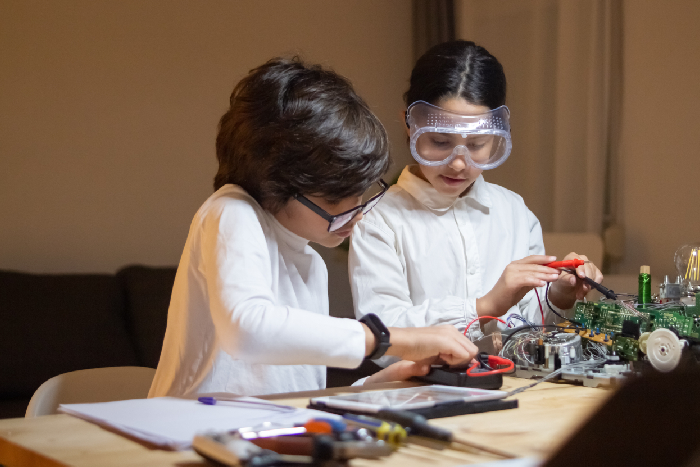
You cannot build real scientific competence by simply drawing diagrams on a blackboard. The school infrastructure Seoni at VPLS features an amazing campus equipped with high-end, international-standard laboratory spaces. Our physics, chemistry, biology, and math labs are designed to be dynamic discovery zones rather than intimidating museums. Every student, not just an elite handful, gets personal access to instruments, experimental kits, and measuring tools. When a child manually calibrates a lens to study light refraction, or blends compounds to see an immediate thermal reaction, the abstract textbook definition becomes a visible reality. This experimental approach turns passive students into active researchers.
Coding and Robotics for All: Demystifying the Digital Architecture
In the modern landscape, digital literacy is a foundational language. At VPLS, our modern way of education treats coding and basic computer robotics not as a special extracurricular activity, but as a core component of analytical development.
In our advanced ICT labs, students learn to build logical loops, debug software, and program physical kits to navigate obstacles. This training does not just prepare them for technology careers; it strengthens their logical reasoning. When a child writes a piece of code, they learn to break a massive, overwhelming problem down into tiny, manageable steps—a core problem-solving framework that can be applied to any discipline in life.
Modern Way of Education: Creating a Safe Space to Fail and Learn
The greatest enemy of learning is the fear of making a mistake. Traditional classrooms often punish incorrect answers, which completely silences a child’s willingness to experiment. At VPLS, we actively celebrate mistakes as vital diagnostic data. If a scientific experiment fails or a math solution goes wrong, our mentors don’t simply give the correct answer. They guide the student to re-trace their steps, locate the exact point of error, and correct the logic independently. This resilient mindset is the true engine of holistic growth , ensuring that students build the mental stamina, grit, and confidence needed to tackle unpredictable problems without looking for a shortcut.
Admissions Open 2026-27: Building Real Analytical Foundations in Seoni
The technological landscape of the 2030s and 2040s will require individuals who can think fluidly and adapt rapidly. As admissions open 2026-27 for Nursery to Class 9, Vardhman Podar Learn School invites you to rescue your child from the stress of traditional memorization. We encourage parents to visit our campus and see how our instructors transform complex equations into engaging activities. By securing your child’s admission for this upcoming session, you are ensuring they receive a world-class, tech-integrated foundation that leaves them completely confident, highly capable, and fully prepared to lead the modern world.
VPLS Group: Engineering the Global Problem-Solvers of Tomorrow
The VPLS Group stands on a century-old foundation of trust, excellence, and continuous educational research across India. We have earned our reputation as the best school in Seoni because we refuse to treat high-quality education as a privilege for a select few. Our brand stands as a trusted promise of world-class learning systems, unparalleled campus security, and a deep commitment to student growth. We do not manufacture children to mimic textbook scripts. We nurture independent, confident, and visionary thinkers who look at complex real-world challenges not as stressful obstacles, but as exciting invitations to innovate, design, and create.
FAQs
How does VPLS Seoni remove the fear of math and science from a child's mind?
We remove fear by completely eliminating rote learning and textbook memorization. Through the practical frameworks of the Podar curriculum, we introduce every single technical concept using real-world objects, hands-on experiments, and digital simulations. When a child sees how a math formula or scientific law directly applies to real life, it transforms from an intimidating symbol into a fascinating, practical tool.
Do regular students get equal access to the high-end labs at VPLS?
Absolutely. We reject the traditional policy of allowing only older students or classroom toppers into laboratory spaces. At VPLS, lab sessions are a mandatory part of the weekly timetable for all grade levels. We ensure that every single child gets personal access to equipment, microscopes, and experiential tools, making practical experimentation a natural part of their daily routine.
Why is coding and robotics taught to students who may not pursue technology careers?
Coding and robotics are not just career tracks; they are powerful tools for developing cognitive logic. When children write simple code or assemble modular robots, they learn computational thinking—how to analyze data, identify logical errors, and break complex challenges into systematic steps. This logical foundation enhances their problem-solving capacity across all academic and real-life areas.
What should I do as a parent if my child is historically weak in mathematics?
The first step is to change the narrative at home by removing the “weak” label. During our admissions open 2026-27 intake, our academic mentors will assess your child’s specific conceptual gaps rather than punishing them for low test scores. We use targeted, multi-sensory learning toolkits and personalized remedial guidance to patch those foundational gaps, building their confidence step-by-step.
How can I inspect your STEM and laboratory infrastructure before applying?
We warmly invite you to book a personalized campus tour of our amazing campus during the admissions open 2026-27 enrollment phase. You can walk through our fully functional science labs, visit our modern computer facilities, view our specialized mathematics toolkits, and speak directly with our STEM educators to understand how our modern way of education makes learning accessible for all.